Casein-Free Diet in Cerebral Folate Deficiency (CFD): Foundation of Treatment and Evidence-Based Effectiveness
V.M. Stefanyshyn, founder of Vivere Clinic, neurologist, geneticist
What Is Cerebral Folate Deficiency (CFD)
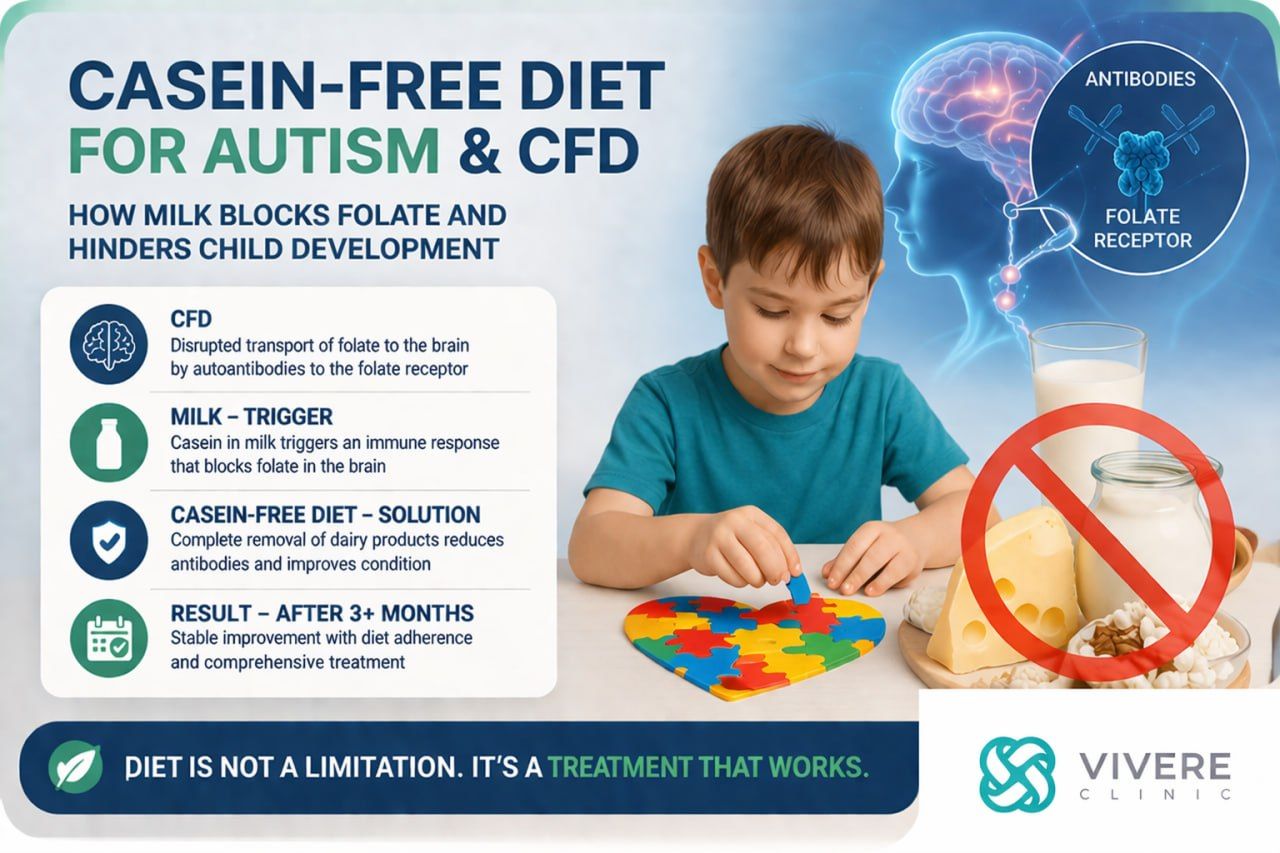
Cerebral folate deficiency (CFD) is a neurological condition in which the level of active folate (5-MTHF) in the cerebrospinal fluid is reduced despite normal blood levels.
The cause is impaired transport of folate to the brain due to autoantibodies to the folate receptor (FR), which block its passage through the blood-brain barrier.
CFD is commonly found in children with:
- autism (ASD);
- developmental delay;
- epilepsy;
- ataxia.
Why Diet Is the Key to Treatment
Folate receptors have a high structural similarity to proteins in cow’s milk, particularly casein. Because of this, milk proteins can trigger an autoimmune response.
The body produces antibodies to casein, which, due to cross-reactivity, block its own receptors in the brain. This directly disrupts folic acid transport and sustains the pathological process.
Thus, dairy products are not just food, but a factor that maintains the disease.
Why a Casein-Free, Not Lactose-Free Diet: A Crucial Distinction
Lactose is a carbohydrate (milk sugar), whereas casein is a protein that triggers the immune response.
Even lactose-free dairy products contain casein and may sustain the autoimmune process.
What a Casein-Free Diet Means
In CFD, it is necessary to completely exclude:
- milk (any kind);
- cheese;
- yogurts;
- cream;
- all products containing casein.
This is a fundamental requirement for effective treatment.
Duration of the Diet: A Critical Success Factor
A casein-free diet requires time.
Clinical data show:
- a decrease in antibodies begins only after 3 months;
- significant improvement occurs within 3–13 months;
- reintroduction of milk quickly increases antibody levels.
Even short-term deviations from the diet (6–14 weeks) can completely negate the results.
Evidence-Based Effectiveness of a Dairy-Free Diet
The study showed:
- a significant reduction in autoantibodies in children on a dairy-free diet;
- no improvement or worsening when dairy products are maintained;
- a rapid increase in antibodies upon reintroduction of milk.
This confirms that a casein-free diet directly affects the mechanism of the disease, not just its symptoms.
Vivere Clinic Approach
At Vivere Clinic, a casein-free diet is a fundamental part of treatment for children with:
- autism and ASD;
- developmental delay;
- PANS/PANDAS.
We use a comprehensive approach:
- FRAT testing (folate receptor antibodies);
- metabolic and genetic diagnostics;
- individual dietary strategy;
- folinic acid therapy.
The diet is the foundation on which the entire therapy is built.
Conclusion
A casein-free diet in cerebral folate deficiency is not a recommendation, but a necessary condition for treatment.
It is dietary control that makes it possible to influence the autoimmune process and achieve stable clinical outcomes.
References
1. Ramaekers V.T., Sequeira J.M., Blau N., Quadros E.V. A milk-free diet downregulates folate receptor autoimmunity in cerebral folate deficiency syndrome, 2008
2. Ramaekers V.T., Blau N. Cerebral folate deficiency. Dev Med Child Neurol, 2004
3. Ramaekers V.T. et al. Autoantibodies to folate receptors in CFD. N Engl J Med, 2005
4. Rothenberg S.P. et al. Folate receptor autoantibodies and neural tube defects. N Engl J Med, 2004
5. Pearce SH, Merriman TR. Genetic progress towards the molecular basis of autoimmunity. Trends Mol Med, 2006